Thursday, January 14, 2021

Our Syllabus, Spring 2021


San Francisco Art Institute | Spring 2021 | CS-301AL-01

“Peace in Pieces”: Histories, Theories, and Practices of Violence and Nonviolent Resistance

Instructor: Dale Carrico; e-mail: dcarrico@sfai.edu; ndaleca@gmail.com

When/Where: Thursdays, 1-3.45pm: Online (ONL- CS1)

Course Blog: https://peaceinpiecessfai.blogspot.com/

Rough Basis for Grade: Attendance/Participation, 15%; In-Class Presentation, 15%; Reading Responses, 15%, Midterm Precis/Toulmin, 3-4pp., 15%; Symposium Presentation, 10%; Final Paper, 8-10pp., 30% (subject to contingencies)

Course Description:

The arc of the moral universe is a longing... and it bends from just us. In this course we will read canonical texts in the theory, history, and practice of nonviolent resistance and world-making. This course is provoked and inspired by stories and strategies of reconciliation connected to traditions of nonviolent politics. But is this "non-violence" simply an alternative, at hand, or is it instead another fraught artifact we are making together under duress? We will take seriously and look critically at the subtle and structural violences that ineradicably shape everyday life. We will also consider testimonies to violation, in a variety of textual forms, while simultaneously considering the cultural ideals of persuasion which often accompany definitions of violence and its limits. We will both take up and take on the many paradoxes of nonviolent activism and violent order that complicate the teaching of what passes for peace: The State as site of violence and alter-violence. Nonviolence, interfaith dialogue, and freethinking. Spontaneity and training. Democracy as assembly, resistance, occupation, and abolition. Prerequisite: Critical Studies A (CS-300) Satisfies: Critical Theory B, Critical Studies Elective, Global Cultures, Liberal Arts elective

Provisional Schedule of Meetings: 
 

Week One | Thursday, January 21 | Introductions 


Week Two | Thursday, January 28 | Consent of the Governed

The Declaration of Independence (US)

Henry David Thoreau, Civil Disobedience

Supplemental Texts:

Howard Zinn, Introduction to Thoreau on Civil Disobedience and Reform

Henry David Thoreau, A Plea for Captain John Brown


Week Three | Thursday, February 4 | Thoreau and Gandhi

Karuna Mantena, The Power of Nonviolence

Logan Rimel, My "Nonviolent" Stance Was Met With Heavily Armed Men

Correspondence of Count Leo Tolstoy with M. K. Gandhi

M. K. Gandhi, The Doctrine of the Sword

M.K. Gandhi, The Meaning and Practice of Ahimsa


Week Four | Thursday, February 11 | Suffragettes

Screen film, "Iron-Jawed Angels," dir. Katja von Garnier

Supplemental Texts:

Emily Thornberry, We Owe It To the Suffragettes To Keep Campaigning for Women

Nadine Bloch, 100 Years Later, Lessons from the Sufferin’Suffragettes

Ken Butigan, Alice Paul's Enduring Legacy of Nonviolent Action 

Jane Addams, New Ideals of Peace: Passing of the War Virtues


Week Five | Thursday, February 18 | King

Rev. Dr. Martin Luther King, Jr., Letter from the Birmingham City Jail

Rev. Dr. Martin Luther King, Jr., Declaration of Independence from the War in Vietnam

Ella J. Baker, Bigger Than A Hamburger  

Supplemental Texts:

Rev. Dr. William J. Barber, II, A Third Reconstruction

William C. Anderson, A Call for Self Defense in the Face of White Supremacy


Week Six | Thursday, February 25 | War

Arundhati Roy, War Is Peace

Chris Hedges, Evidence of Things Not Seen

Gene Sharp, selections from How Non-Violent Struggle Works

Marcie Smith, Gene Sharp: The Cold War Intellectual Whose Ideas Seduced the Left


Week Seven | Thursday, March 4 | Argument

Karl Rogers and Rogerian Synthesis

The Toulmin Schema

William May, Rising to the Occasion of Our Death (handout)

Be Water: Seven Tactics in Hong Kong’s Democracy Revolution


Week Eight | Thursday, March 11 | Fanon and Arendt

Frantz Fanon, Concerning Violence

Hannah Arendt, Reflections On Violence and “Must Eichmann Hang?”
Ta-Nehisi Coates, The Case for Reparations


Week Nine | Thursday, March 18 | Spring Break


Week Ten | Thursday, March 25 | A History of Violence 

Screen film, “A History of Violence,” dir. David Cronenberg


Week Eleven | Thursday, April 1 | A History of Violence

Discuss film, and circle back to neglected texts.


Week Twelve | Thursday, April 8 | Octavia Butler

Octavia Butler, Kindred


Week Thirteen | Thursday, April 15 | Decarceration Unto Abolition

Angela Davis, selections from Are Prisons Obsolete?

Supplemental: Nick Estes, Fighting For Our Lives: #NoDAPL in Historical Context


Week Fourteen | Thursday, April 22 | Slow Violence and Animal Abuse

Rob Nixon, Slow Violence and the Environmentalism of the Poor
Carol Adams, An Animal Manifesto

Carol Adams, Beastliness and a Politics of Solidarity


Week Fifteen | Thursday, April 29 | Symposium (Office Hour Marathon)

Final Project Symposium


Week Sixteen | Thursday, May 6 | Conclusions

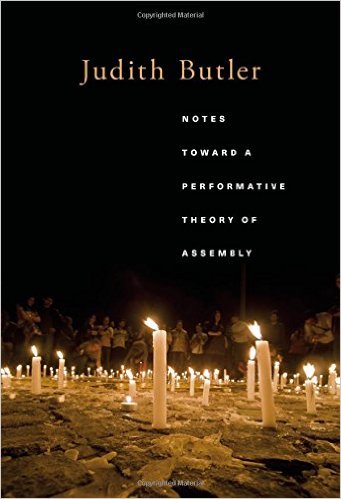
Judith Butler, selections from The Force of Nonviolence


Course Objectives:

Survey canonical texts in the history, theory, and practice of nonviolent resistance: Thoreau, Tolstoy, Gandhi, King, Sharp, Zinn, Davis and abolition democracy. Consider texts applying and criticizing this canonical history in contemporary contexts.

Address further questions of structural violence, marginalization, exploitation, and oppression. Consider the in/adequacy of their address within the terms of the canon of nonviolence.

Provide a basic toolkit of critical thinking, reading, and writing skills. Use this instruction as an occasion to elaborate but also pressure the traditional distinction of persuasion from violence.

Tuesday, November 21, 2017

Workshop Worksheet


This is the worksheet we followed for our Final Project workshop last week. If you would like to do the Workshop again on your own -- for another paper in another course, or because you have changed your mind about the paper you are writing for this course, whatever -- you are always welcome to do so. Good luck and I hope you are all having a good break!

Final Paper/Close Argumentative Reading Workshop Worksheet

Your Name: __________________________________________________________________________________________

The Text You Are Reading Closely in Your Argument: _______________________________________________________
BRAINSTORM! Take 20 mins. or so to write down 20-30 claims about your chosen text. Don't worry whether these claims are "deep," just write down claims you think are true and interesting about the text and be as clear and specific as you can.

1.

2.

3.

4.

5.

6.

7.

8.

9.

10.

11.

12.

13.

14.

15.

16.

17.

18.

19.

20.

21.

22.

23.

24.
Continue on the back of the page if you like. The more claims you have to work with, the better.
Final Paper/Close Argumentative Reading Workshop Worksheet (PART TWO: In Class)

Your Name: __________________________________________________________________________________________

The Text You Are Reading Closely in Your Argument: _______________________________________________________
I. In groups of three: Discuss your BRAINSTORM and then PICK THE THREE BEST THESIS CANDIDATE CLAIMS and write them down in their best, clearest form here (Twenty-Four Minutes):

1.

2.

3.

II. Now on your own, for each of your three thesis candidate claims COME UP WITH THE STRONGEST OR MOST OBVIOUS OPPOSITION TO EACH THESIS (Ten Minutes):

1.

2.

3.

III. In NEW groups of three: Discuss your thesis candidates and their OPPOSITIONS and write down the results, reconsiderations, and re-edits here (Twenty-Four Minutes):

1.

2.

3.

IV. On your own, pick the strongest thesis and its best opposition and write them down in the template below (Five Minutes):

V. In NEW groups of three discuss your text, thesis, opposition, and textual moments that may support the thesis or provide a means to circumvent its objection. Also, determine whether any key terms need definitions (Thirty-Six Minutes):

Thesis:

1. (textual support)


2. (textual support)


3. (textual support)


Opposition:

(textual circumvention)


Terms requiring definition?

Wednesday, November 8, 2017

Class Cancelled Tomorrow -- Nov. 9

Hello to all, this is Dale Carrico. A family emergency has arisen and I am
going to have to cancel our meeting for tomorrow, Thursday, November 9.

Next week we are scheduled to do a workshop to assist you in writing your final
papers. I have posted on our blog the handout "Four Habits of Argumentative
Writing" which I was going to cover in class tomorrow. The workshop will help
ensure all four habits are exhibited in your paper. You will be handing in the
work you do in the workshop with your final papers, so next week's class cannot
be missed. Before you come to class next week you need to decide which of the
texts assigned in the class over this term you think you want to write about
for your final paper -- since there are no assigned texts for next week I
strongly suggest you prepare by re-reading your chosen text so that it is fresh
in your minds as you do the workshop next week in class.

I hope everybody has a good week, I will miss you all tomorrow. Best, d

Tuesday, October 24, 2017

Hannah Arendt from The Human Condition


33 -- I R R E V E R S I B I L I T Y  A N D  T H E  P O W E R  T O  F O R G I V E
We have seen that the animal laborans could be redeemed from its predicament of imprisonment in the ever-recurring cycle of the life process, of being forever subject to the necessity of labor and consumption, only through the mobilization of another human capacity, the capacity for making, fabricating, and producing of homo faber, who as a toolmaker not only eases the pain and trouble of laboring but also erects a world of durability. The redemption of life, which is sustained by labor, is worldliness, which is sustained by fabrication. We saw furthermore that homo faber could be redeemed from his predicament of meaninglessness, the "devaluation of all values," and the impossibility of finding valid standards in a world determined by the category of means and ends, only through the interrelated faculties of action and speech, which produce meaningful stories as naturally as fabrication produces use objects. If it were not outside the scope of these considerations, one could add the predicament of thought to these instances; for thought, too, is unable to "think itself" out of the predicaments which the very activity of thinking engenders. What in each of these instances saves man—man qua animal laborans, qua homo faber, qua thinker— is something altogether different; it comes from the outside—not, to be sure, outside of man, but outside of each of the respective activities. From the viewpoint of the animal laborans, it is like a miracle that it is also a being which knows of and inhabits a world; from the viewpoint of homo faber, it is like a miracle, like the revelation of divinity, that meaning should have a place in this world.
The case of action and action's predicaments is altogether different. Here, the remedy against the irreversibility and unpredictability of the process started by acting does not arise out of another and possibly higher faculty, but is one of the potentialities of action itself. The possible redemption from the predicament of irreversibility—of being unable to undo what one has done though one did not, and could not, have known what he was doing—is the faculty of forgiving. The remedy for unpredictability, for the chaotic uncertainty of the future, is contained in the faculty to make and keep promises. The two faculties belong together in so far as one of them, forgiving, serves to undo the deeds of the past, whose "sins" hang like Damocles' sword over every new generation; and the other, binding oneself through promises, serves to set up in the ocean of uncertainty, which the future is by definition, islands of security without which not even continuity, let alone durability of any kind, would be possible in the relationships between men.
Without being forgiven, released from the consequences of what we have done, our capacity to act would, as it were, be confined to one single deed from which we could never recover; we would remain the victims of its consequences forever, not unlike the sorcerer's apprentice who lacked the magic formula to break the spell. Without being bound to the fulfillment of promises, we would never be able to keep our identities; we would be condemned to wander helplessly and without direction in the darkness of each man's lonely heart, caught in its contradictions and equivocalities —a darkness which only the light shed over the public realm through the presence of others, who confirm the identity between the one who promises and the one who fulfils, can dispel. Both faculties, therefore, depend on plurality, on the presence and acting of others, for no one can forgive himself and no one can fed bound by a promise made only to himself; forgiving and promising enacted in solitude or isolation remain without reality and can signify no more than a role played before one's self.
Since these faculties correspond so closely to the human condition of plurality, their role in politics establishes a diametrically different set of guiding principles from the "moral" standards inherent in the Platonic notion of rule. For Platonic rulership, whose legitimacy rested upon the domination of the self, draws its guiding principles—those which at the same time justify and limit power over others—from a relationship established between me and myself, so that the right and wrong of relationships with others are determined by attitudes toward one's self, until the whole of the public realm is seen in the image of "man writ large," of the right order between man's individual capacities of mind, soul, and body. The moral code, on the other hand, inferred from the faculties of forgiving and of making promises, rests on experiences which nobody could ever have with himself, which, on the contrary, are entirely based on the presence of others. And just as the extent and modes of self-rule justify and determine rule over others—how one rules himself, he will rule others—thus the extent and modes of being forgiven and being promised determine the extent and modes in which one may be able to forgive himself or keep promises concerned only with himself.
Because the remedies against the enormous strength and resiliency inherent in action processes can function only under the condition of plurality, it is very dangerous to use this faculty in any but the realm of human affairs. Modern natural science and technology, which no longer observe or take material from or imitate processes of nature but seem actually to act into it, seem, by the same token, to have carried irreversibility and human unpredictability into the natural realm, where no remedy can be found to undo what has been done. Similarly, it seems that one of the great dangers of acting in the mode of making and within its categorical framework of means and ends lies in the concomitant self-deprivation of the remedies inherent only in action, so that one is bound not only to do with the means of violence necessary for all fabrication, but also to undo what he has done as he undoes an unsuccessful object, by means of destruction. Nothing appears more manifest in these attempts than the greatness of human power, whose source lies in the capacity to act, and which without action's inherent remedies inevitably begins to overpower and destroy not man himself but the conditions under which life was given to him.
The discoverer of the role of forgiveness in the realm of human affairs was Jesus of Nazareth. The fact that he made this discovery in a religious context and articulated it in religious language is no reason to take it any less seriously in a strictly secular sense. It has been in the nature of our tradition of political thought (and for reasons we cannot explore here) to be highly selective and to exclude from articulate conceptualization a great variety of authentic political experiences, among which we need not be surprised to find some of an even elementary nature. Certain aspects of the teaching of Jesus of Nazareth which are not primarily related to the Christian religious message but sprang from experiences in the small and closely knit community of his followers, bent on challenging the public authorities in Israel, certainly belong among them, even though they have been neglected because of their allegedly exclusively religious nature. The only rudimentary sign of an awareness that forgiveness may be the necessary corrective for the inevitable damages resulting from action may be seen in the Roman principle to spare the vanquished (parcere subiectis)—a wisdom entirely unknown to the Greeks—or in the right to commute the death sentence, probably also of Roman origin, which is the prerogative of nearly all Western heads of state….
Crime and willed evil are rare, even rarer perhaps than good deeds… But trespassing is an everyday occurrence which is in the very nature of action's constant establishment of new relationships within a web of relations, and it needs forgiving, dismissing, in order to make it possible for life to go on by constantly releasing men from what they have done unknowingly. Only through this constant mutual release from what they do can men remain free agents, only by constant willingness to change their minds and start again can they be trusted with so great a power as that to begin something new. In this respect, forgiveness is the exact opposite of vengeance, which acts in the form of re-acting against an original trespassing, whereby far from putting an end to the consequences of the first misdeed, everybody remains bound to the process, permitting the chain reaction contained in every action to take its unhindered course. In contrast to revenge, which is the natural, automatic reaction to transgression and which because of the irreversibility of the action process can be expected and even calculated, the act of forgiving can never be predicted; it is the only reaction that acts in an unexpected way and thus retains, though being a reaction, something of the original character of action. Forgiving, in other words, is the only reaction which does not merely re-act but acts anew and unexpectedly, unconditioned by the act which provoked it and therefore freeing from its consequences both the one who forgives and the one who is forgiven. The freedom contained in Jesus' teachings of forgiveness is the freedom from vengeance, which encloses both doer and sufferer in the relentless automatism of the action process, which by itself need never come to an end.
The alternative to forgiveness, but by no means its opposite, is punishment, and both have in common that they attempt to put an end to something that without interference could go on endlessly. It is therefore quite significant, a structural element in the realm of human affairs, that men are unable to forgive what they cannot punish and that they are unable to punish what has turned out to be unforgivable. This is the true hallmark of those offenses which, since Kant, we call "radical evil" and about whose nature so little is known, even to us who have been exposed to one of their rare outbursts on the public scene. All we know is that we can neither punish nor forgive such offenses and that they therefore transcend the realm of human affairs and the potentialities of human power, both of which they radically destroy wherever they make their appearance. Here, where the deed itself dispossesses us of all power, we can indeed only repeat with Jesus: "It were better for him that a millstone were hanged about his neck, and he cast into the sea."
Perhaps the most plausible argument that forgiving and acting are as closely connected as destroying and making comes from that aspect of forgiveness where the undoing of what was done seems to show the same revelatory character as the deed itself. Forgiving and the relationship it establishes is always an eminently personal (though not necessarily individual or private) affair in which what was done is forgiven for the sake of who did it…. [L]ove, although it is one of the rarest occurrences in human lives, indeed possesses an unequaled power of self-revelation and an unequaled clarity of vision for the disclosure of who, precisely because it is unconcerned to the point of total unworldliness with what the loved person may be, with his qualities and shortcomings no less than with his achievements, failings, and transgressions….  Respect, not unlike the Aristotelian philia politike, is a kind of "friendship" without intimacy and without closeness; it is a regard for the person from the distance which the space of the world puts between us, and this regard is independent of qualities which we may admire or of achievements which we may highly esteem. Thus, the modern loss of respect, or rather the conviction that respect is due only where we admire or esteem, constitutes a clear symptom of the increasing depersonalization of public and social life. Respect, at any rate, because it concerns only the person, is quite sufficient to prompt forgiving of what a person did, for the sake of the person. But the fact that the same who, revealed in action and speech, remains also the subject of forgiving is the deepest reason why nobody can forgive himself; here, as in action and speech generally, we are dependent upon others, to whom we appear in a distinctness which we ourselves are unable to perceive.
Closed within ourselves, we would never be able to forgive ourselves any failing or transgression because we would lack the experience of the person for the sake of whom one can forgive.

Friday, September 8, 2017

A Link For Next Week Has Changed on Our Syllabus

Be sure to read The Meaning and Power of Ahimsa for next week, I switched one of our Gandhi readings. The syllabus has been updated, but I wanted to make sure everybody saw it. Have a great weekend, all! d

Tuesday, September 5, 2017